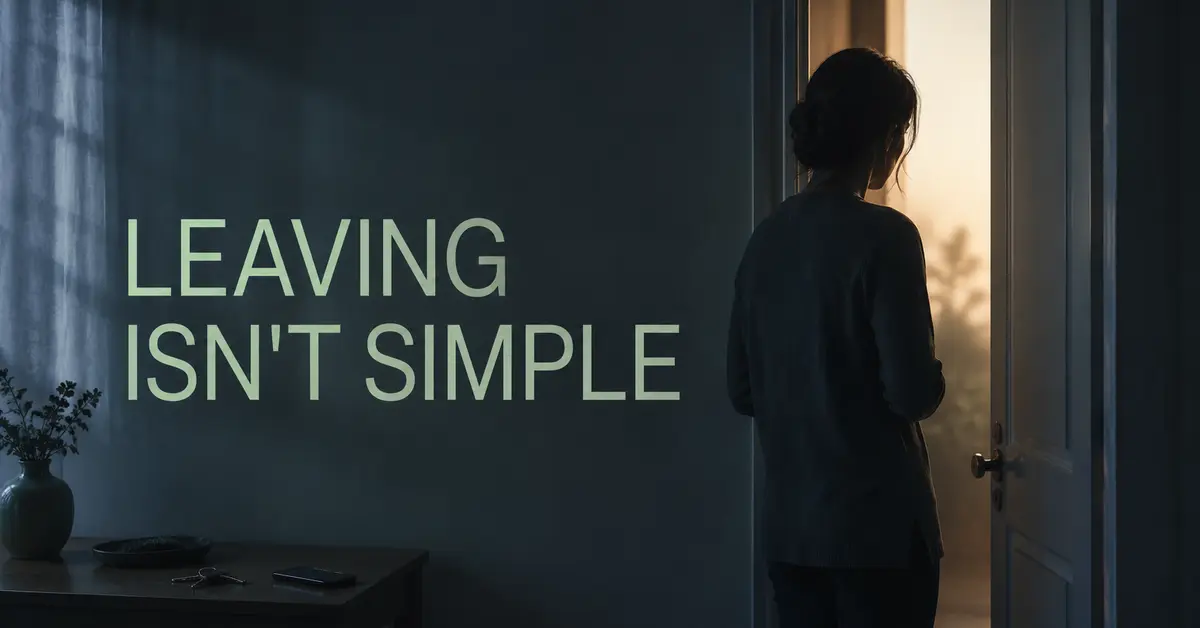
One of the hardest questions a survivor of intimate partner violence can hear is also one of the simplest: “Why didn’t you just leave?” There was a time when I might have wondered the same thing. From the outside, leaving seems obvious. If someone is hurting you, get away. Pack a bag. Open the door. Call the police. Go to a friend’s house. End the relationship. I wish it were that simple.
By the time I understood how dangerous my relationship had become, leaving was no longer one decision. My life had slowly been rearranged around another person’s moods, suspicions, threats, and need for control. My keys could disappear. My purse could be taken. My phone could be removed from my reach. A conversation could be overheard. A trip outside could lead to an accusation. A call from a friend could change the entire mood of the house. Even opening the blinds could become a reason for anger.
That is what people sometimes miss when they ask why a survivor stayed. They are looking at the door. The survivor is looking at everything that might happen if she tries to walk through it.
A Cage Does Not Always Have Bars
When people picture abuse, they often picture the worst moment. They picture the bruise, the scream, the threat, or the hand raised in anger. Those things are real, but there can be another kind of imprisonment happening long before anyone sees physical evidence.
Control can enter a relationship quietly. At first, it may sound like concern. Someone wants to know who called you, where you were, why you took so long, or why you need to go somewhere without them. Over time, the questions become accusations. The accusations become rules. The rules become fear.
Before long, you are measuring every word before you speak it. You are listening to footsteps in another room and trying to determine what kind of mood is coming toward you. You are studying a face, a tone of voice, or the way a door closes. You are no longer simply living in your home. You are managing danger inside it.
That was one of the most difficult things for me to understand about my own situation. There was no single day when somebody handed me a list of rules and told me I was no longer free. My freedom disappeared in pieces. Because it happened in pieces, I kept adjusting to each new restriction.
Your World Can Become Smaller Without You Realizing It
One of the cruelest parts of controlling behavior is how slowly it can shrink a person’s world. Friends become harder to talk to. Work becomes a source of conflict. Family conversations have to be shortened or hidden. Your phone becomes something you worry about instead of something that connects you to people. You begin changing ordinary habits because you know they might cause an argument.
Eventually, your entire life becomes organized around preventing the next explosion.
I knew what it was like to want peace so badly that I would change my own behavior just to keep the temperature in the room from rising. I knew what it was like to have my keys and purse taken away. I knew what it was like to realize that the things most people take for granted—a phone, transportation, privacy, an unlocked door—could become lifelines.
I also knew what it was like to keep smiling for the outside world while knowing what waited for me at home. That is why “just leave” can sound so painful to a survivor. Leaving requires choices, and abuse is often built around taking choices away.
Fear Changes the Way You Think
People sometimes mistake a survivor’s hesitation for weakness. It is not weakness. Imagine having to calculate the possible consequences of every decision. If I make this call, will he hear me? If I tell someone, will they believe me? If I leave now, will he follow me? If I take my belongings, will he notice? If I go for help and nobody is there, what happens when I have to return?
These were not imaginary fears to me. They were questions tied to real consequences.
At one point, I tried to reach a police substation, believing I was finally moving toward safety. When I arrived, I found it closed because of COVID. I had made it out. I had reached the place I believed would help me, and the door was closed. Then I had to face what came next.
Experiences like that change the meaning of the word “leave.” It is no longer only about courage. It becomes about timing, safety, transportation, money, documents, a phone, a place to go, and whether there is someone on the other end who will answer and believe you.
Survival Can Look Like Staying
This is something I want people to understand. Sometimes surviving does not look brave from the outside. Sometimes it looks like silence. Sometimes it looks like agreeing because arguing is too dangerous. Sometimes it looks like pretending everything is normal. Sometimes it looks like waiting for the right moment.
Sometimes survival means putting a little money aside where no one will find it. It can mean hiding an extra phone, preparing a change of clothes, telling a trusted friend what is happening, or arranging for someone to call for help if you fail to check in.
Those actions may look small to someone living safely. When you are living with fear, they are not small at all. They may be the first pieces of an escape plan.
For a long time, I had to think several moves ahead. I learned to prepare without making it obvious that I was preparing. Emergency cash, extra clothes, and a spare phone became more than ordinary objects. They became pieces of freedom.
I was not doing nothing. I was surviving while trying to find a safe way out. There is a difference.
The First Escape May Not Be the Final Escape
Another thing people rarely understand is that trying to leave does not always mean you immediately become free. An attempt can fail. A survivor can return. Fear can pull someone back. Financial pressure can pull someone back. Promises can pull someone back. Threats can pull someone back. Hope can pull someone back. Sometimes there simply is nowhere safe to go at that moment.
None of those things mean the survivor wanted the abuse. None of them erase the courage it took to try.
I had moments when I thought I was finally breaking free, only to find myself pulled back into the same nightmare. Each failed attempt could have convinced me that escape was impossible. Instead, somewhere inside me, a small voice kept telling me there had to be a way out.
That voice mattered. Even before I was physically free, some part of me had begun fighting for my life again.
One Safe Person Can Change Everything
Abuse grows stronger in isolation. That is why safe people matter so much. A friend who notices something is wrong matters. A neighbor who takes a concern seriously matters. A family member who listens without judgment matters. A professional who understands intimate partner violence matters.
My own escape became more possible when I stopped carrying the truth entirely by myself. People in my life began seeing what I was trying so hard to hide. Friends noticed the fear. They noticed the changes in me. They began checking on me.
One friend helped create a safety window. If I failed to respond within an agreed amount of time, she knew to call the police. That may sound like a simple arrangement, but to me it meant somebody was watching the clock when I could not safely ask for help myself.
Later, the House of Ruth Maryland gave me something I desperately needed: people who understood that safety required more than simply telling me to leave. They helped me think through real steps. A protective order. A protected address. An escape route. A plan. For the first time, safety began to feel less like a wish and more like something that could actually be built.
Stop Asking, “Why Did You Stay?”
Instead of asking a survivor, “Why did you stay?” perhaps we should ask, “What made leaving so difficult?” That question opens a door instead of closing one.
It allows us to understand the fear, the financial control, the isolation, the threats, the confusion, the surveillance, the hope that the person will change, and the practical problem of finding somewhere safe. It also allows us to recognize that the very systems a survivor expects to protect them may sometimes fail at the moment they are needed most.
We can also ask what the person needs right now, how we can help them feel safer, whether there is someone they trust, and whether they want help contacting a support service. Those questions do not judge. They create room for the survivor to make choices again.
When someone has spent months or years having their choices taken away, that room matters.
Leaving Begins Before the Door Opens
Looking back, I can see that my escape began long before I physically left. It began when I stopped accepting every accusation as truth. It began when I recognized that fear was not love. It began when I told another person what was happening. It began when I hid resources and made plans. It began when I started listening to my own instincts again.
The physical escape came later. Freedom began inside me first.
That is why I no longer judge the woman I was for not leaving sooner. I know what she was doing. She was watching. Learning. Waiting. Preparing. Surviving.
And eventually, she was ready.
What I Want Every Survivor to Hear
If you are living through something similar, I will not ask you why you have not left. I know there may be reasons no one else can see. I know you may be doing more to survive than anyone around you realizes. I know there may be a war going on behind an ordinary front door.
But I also want you to remember something I had to learn for myself. You are still there. The part of you that knows something is wrong is still there. The part of you that remembers who you were before the fear is still there. The part of you that wants peace is still there.
Listen to that part of yourself. Protect it. Tell someone safe when you can. Keep hold of the truth even when someone tries to rewrite it for you.
Your life belongs to you. Your voice belongs to you. Your choices belong to you. The fact that someone has spent time trying to take those things away does not mean they are gone forever.
About the Book
Unmasking the Monster: A True Story of Surviving IPV tells the story of how a relationship that began with love, laughter, and hope slowly became what I came to know as my “house of terror.”
It is not only a story about what happened behind closed doors. It is a story about the things people often cannot see—the isolation, the constant fear, the questioning of your own reality, the failed attempts to get away, the quiet planning, and the strength it takes to keep believing that another life is possible.
I wrote this book for survivors, but I also wrote it for the people who love them. I want readers to understand why leaving an abusive relationship can be far more complicated than walking through a door. I want friends, relatives, neighbors, healthcare workers, and others to understand how powerful it can be simply to listen, believe, and help someone make a safe plan.
Most of all, I want the person still living inside their own “house of terror” to know that you do not have to prove how badly you are hurting before your life is worth protecting. You do not have to explain your survival to people who have never had to live it. And you do not have to remain trapped in the chapter you are living today. There are more pages ahead.