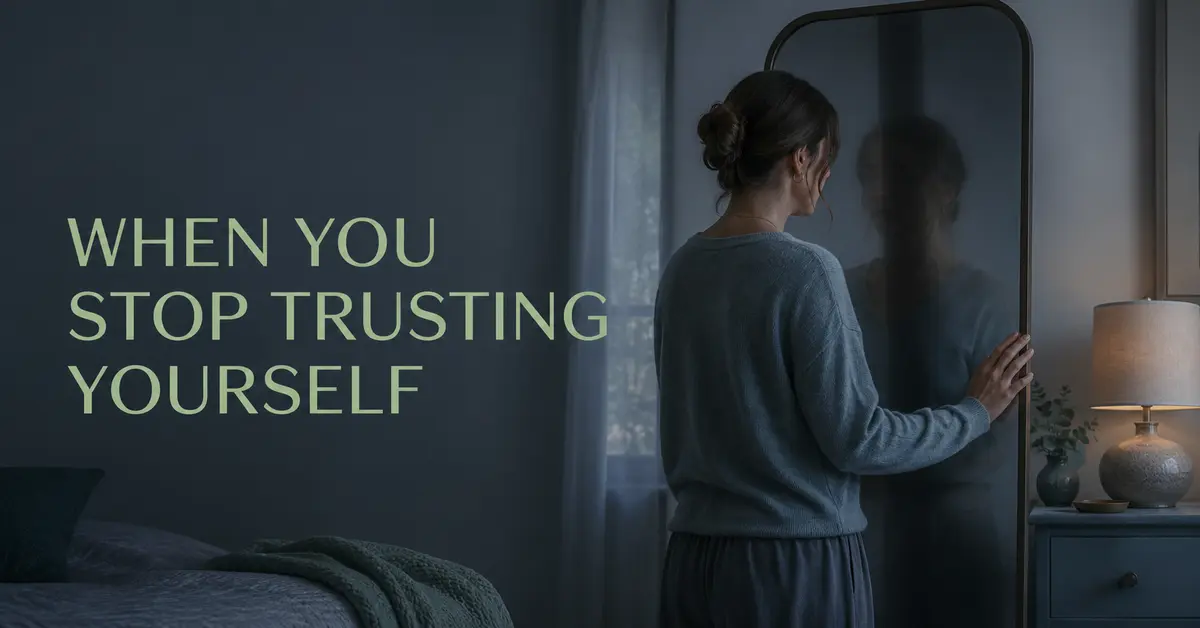
There is a voice inside us that often knows the truth before we are ready to accept it. Sometimes it speaks through a knot in the stomach. Sometimes it is the sudden feeling that something is not right, even when everything looks fine on the surface. Sometimes it is a thought that arrives quietly and disappears almost as quickly: That hurt. That was not normal. Why did he say that? Why am I afraid? I heard that voice for a long time, but I did not always listen to it.
When my relationship began, I was looking through what I later came to recognize as rose-colored glasses. I saw charm, laughter, affection, and possibility. I felt seen. I felt wanted. I believed I had found someone whose wounds could be understood and whose life could become better with enough love, patience, and healing. Then little things began to change. A comment did not feel quite like a joke. A look lasted a little too long. Jealousy was presented as love. Questions sounded harmless until I realized I was answering them more and more often. Criticism was followed by explanations of why I had misunderstood what had been said. At first, none of these moments seemed large enough to change the way I saw the relationship, but my body noticed them. My intuition noticed them. Something inside me was already whispering that the beautiful picture I had been given was beginning to crack.
I did not immediately think, This is abuse. Instead, I questioned myself. Maybe I was overreacting. Maybe I had misunderstood him. Maybe he was stressed. Maybe his health was frightening him. Maybe I had said something the wrong way. Maybe I was being too sensitive. Those “maybes” became a dangerous place to live. Whenever something happened that made me uncomfortable, I searched for an explanation that would make the discomfort disappear. I had always been someone who tried to understand people. I knew pain could shape behavior, and I believed compassion could reach places anger could not. So instead of trusting what I felt, I explained it away.
The strange thing about losing trust in yourself is that it rarely happens in one dramatic moment. There is no morning when you wake up and suddenly decide your judgment no longer matters. It happens one question at a time. Did that really happen the way I remember it? Was he actually angry, or did I make too much of it? Did he mean to hurt me? Am I being unfair? Maybe I am the problem. Eventually, you begin looking to the very person who is hurting you to tell you whether your pain is real. That is when your inner compass begins to disappear.
Gaslighting can make ordinary life feel like a courtroom where you are constantly required to prove your own experience. Something happens and you know what you saw. You know what you heard. You know how it made you feel. Then you are told that it did not happen that way. You misunderstood. You forgot. You caused it. You are too emotional. You are imagining things. You are the one with the problem. After hearing those messages often enough, certainty becomes difficult.
I began questioning my own perceptions. I could walk away from a confrontation knowing exactly what had happened and, hours later, find myself wondering whether I had somehow caused the entire thing. That confusion did not remain inside arguments. It followed me everywhere. I started choosing my words carefully. I watched facial expressions. I listened to the way doors closed. I noticed changes in tone. I learned to sense the mood of the house before I even considered my own mood. I became an expert at reading someone else and a stranger to myself. That may be one of the cruelest things about emotional abuse. It does not only make you afraid of another person. It can make you afraid to trust your own mind.
People use the phrase “walking on eggshells” casually, but living that way is exhausting. When you are constantly trying to prevent another person’s anger, your attention moves away from your own life. You begin thinking several steps ahead. Should I answer the phone? Should I mention where I am going? Should I open the blinds? Should I call my friend back? Should I say what I really think? Should I stay quiet? Ordinary choices become possible dangers.
That happened to me. Things that once required no thought became decisions I had to calculate. My freedom became smaller, but because it disappeared gradually, I adjusted to each new limitation. I told myself I was keeping the peace, but peace built on fear is not peace. It is survival, and there is a difference.
People sometimes imagine an abusive relationship as being terrible every minute of every day. Mine was not. There were moments of laughter. There were apologies. There were ordinary conversations. There were memories of the man I believed I had fallen in love with. Those moments mattered because they kept hope alive. After anger came calm, and during the calm I wanted to believe the storm had finally passed. A kind gesture could make me wonder whether I had judged everything too harshly. An apology could make me believe change was coming. A shared laugh could bring back the person I remembered from the beginning.
I kept searching for that man. I kept believing that if I could reach him, understand him, support him, or help him heal, perhaps everything would return to the way it had been. But the good moments did not erase the fear. Eventually, I had to stop judging the relationship only by its best days. I had to look at how I lived every day. Was I safe? Was I free to speak? Could I disagree without being afraid? Could I talk to friends without consequences? Could I leave the house without suspicion? Could I simply be myself? Those questions told me far more than another apology ever could.
Looking back, I realize my body was telling me the truth long before I was willing to name it. The tension in my stomach was telling me something. The way I flinched at certain sounds was telling me something. The fear I felt when the front door opened was telling me something. The relief I sometimes felt when I was alone was telling me something. I had spent years encouraging other people to connect with themselves, yet I had learned to ignore the signals coming from my own body.
I once thought intuition had to arrive as some dramatic revelation. It does not. Sometimes intuition is simply discomfort that refuses to leave. Sometimes it is the realization that you are explaining the same behavior for the tenth time. Sometimes it is noticing that you feel safer when a person is gone than when they are beside you. Sometimes it is hearing yourself say, “Everything is fine,” while something inside you quietly answers, No, it isn’t.
One reason I ignored my instincts was because I understood that Steve carried pain of his own. I knew pieces of his history. I knew there were wounds behind some of what I saw. The healer in me wanted to reach the injured person beneath the anger. But one of the hardest lessons of my life was learning that understanding why someone behaves a certain way does not require you to accept what they do to you. A painful past does not make another person’s suffering acceptable. Trauma may help explain behavior, but explanation is not permission. Mental health struggles do not erase responsibility for choices that harm and control another human being.
I could have compassion for what had happened to him while still recognizing what was happening to me. That distinction changed everything. For years, I had been asking myself why he was behaving that way. Eventually, I began asking a more important question: What is this behavior doing to me? That was the question that brought my own life back into the picture.
Reclaiming self-trust did not happen all at once. At first, it was fragile. It began when I allowed myself to admit that something was wrong without immediately explaining it away. It grew when I spoke honestly to people I trusted. It grew when someone else looked at what I had been living through and did not minimize it. It grew when I stopped treating my fear as evidence that I was weak and started recognizing that fear had been warning me.
Little by little, I began believing my own memories again. I began believing my own discomfort. I began believing the woman in the mirror. That was a powerful shift because control depends on confusion. The more clearly I could see what was happening, the harder it became to convince me that it was normal. I did not need his permission to call something cruel. I did not need his agreement before I could say I was afraid. I did not need anyone else to approve my reality before it became real. My experience belonged to me, and so did my voice.
For me, healing was not simply about escaping the relationship. I also had to repair the relationship I had with myself. I had spent so much time studying someone else’s moods that I had forgotten to ask how I felt. I had spent so much time questioning my reactions that I had to learn how to trust them again. That meant paying attention when something felt wrong. It meant allowing discomfort to matter. It meant understanding that boundaries are not cruel. It meant learning that “no” does not require a long explanation afterward. It meant recognizing that love should never require me to surrender my dignity, freedom, or sense of reality.
Most importantly, it meant forgiving myself for the times I had ignored what I knew. I cannot go back and tell the woman I was to leave at the first warning sign, but I can speak to her differently now. I can tell her she was not foolish for loving. I can tell her hope made her stay longer than she should have. I can tell her that her compassion was real, even when it was given to someone who used it against her. And I can tell her that the quiet voice she kept pushing aside never truly disappeared. It waited.
We often think warning signs will arrive like sirens, but sometimes they arrive as whispers. A strange feeling after an argument. A joke that leaves you embarrassed instead of laughing. An apology that never leads to changed behavior. Jealousy presented as devotion. Possessiveness presented as protection. Questions that slowly become interrogation. Rules you never agreed to but somehow find yourself following. The growing feeling that you are becoming smaller so another person can remain comfortable.
You do not have to wait until your life becomes unbearable before your discomfort deserves attention. You do not have to collect enough evidence to convince everyone around you. You do not have to silence yourself simply because someone else keeps insisting that your reality is wrong. Sometimes the first step toward freedom is not walking through a door. Sometimes it is looking at yourself and saying, I believe you.
About the Book
Unmasking the Monster: A True Story of Surviving IPV is my story of love, control, fear, survival, and the long journey back to myself. It follows a relationship that began with charm and possibility and slowly became a life shaped by manipulation, isolation, violence, and doubt. But this is not only a story about recognizing the monster in another person. It is also about recognizing the warrior within yourself.
I wrote this book because intimate partner violence does not always begin with something obvious. Sometimes it begins in the small moments we dismiss, the uncomfortable feelings we explain away, and the questions we stop asking because we are afraid of the answers. My hope is that someone reading my story will listen to themselves a little sooner than I did. If something inside you keeps whispering that something is wrong, do not ignore that voice. Listen to it. It may be the part of you that still remembers exactly who you are.